
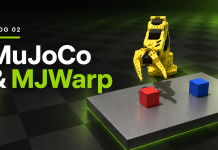


A Hugging Face guide walks an SO-101 arm from single-core MuJoCo to batched GPU simulation, keeping physics and learning data on device.
Hugging Face published a guide showing how to move a MuJoCo robot model onto GPUs with MuJoCo Warp, or MJWarp, which builds on the NVIDIA Warp framework. The walkthrough takes an SO-101 follower arm from a single CPU simulation to as many as 2,048 parallel environments.
Classic MuJoCo runs fast CPU-based simulation and parallelizes sampling across CPU cores. As learning workloads grow, the constraint shifts from how fast one world advances to how many worlds run at once. NVIDIA Warp provides statically typed Python kernels that compile to CPU or CUDA, and MJWarp implements MuJoCo physics on top of that layer.
Builders who need single-robot MPC or teleoperation can stay on MuJoCo CPU, while teams chasing raw throughput on MuJoCo physics should reach for MJWarp or mjlab. JAX training recipes map to MuJoCo Playground and MJX with the warp implementation. Keeping simulation and learning data close to the device reduces host-device transfer overhead.
The guide prepares and scales the simulation environment but does not train a policy. Later installments in the series cover Newton and Isaac Lab, which add a multi-solver API, USD support, sensors, managers, and training loops. Operators evaluating physical AI pipelines should watch how those integration layers connect simulation to real training.
What matters
- MuJoCo Warp runs the same MJCF models on NVIDIA GPUs, scaling one robot arm to 2,048 parallel environments.
- Batching worlds on GPU keeps simulation and learning data on device, cutting host-device transfer overhead.
- Newton and Isaac Lab posts come next, covering multi-solver APIs, USD assets, sensors, and training loops.
Why it matters
Newton and Isaac Lab posts come next, covering multi-solver APIs, USD assets, sensors, and training loops.
This GenAI News article was prepared in original wording using reporting and materials published by Hugging Face Blog. Source reference: https://huggingface.co/blog/nvidia/how-to-use-nvidia-warp-and-mjwarp.
Drafted by the GenAI News review pipeline.