
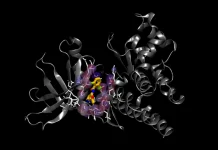


NVIDIA’s modular C API library ships with an OpenMM plugin that swaps nonbonded forces, Langevin integrators, and barostats.
NVIDIA released cuPotential, a library of modular C API primitives that handle the long-range interactions dominating classical molecular dynamics workloads. The package includes direct-space evaluators, reciprocal-space routines, and charge-spreading functions, plus an OpenMM plugin that replaces nonbonded forces, the Langevin integrator, and a Monte Carlo barostat with drop-in substitutes.
Molecular dynamics codes were among the first scientific workloads ported to GPUs because atom-pair evaluations parallelize well. Kernel tuning and hardware compatibility grew harder with each GPU generation. NVIDIA built cuPotential with D. E. Shaw Research and the Flatiron Institute, whose splitting and spreading functions hit target accuracy at coarser grids and shorter cutoffs than standard Ewald methods.
Teams running OpenMM simulations see end-to-end speedups of roughly 2x to more than 3x on systems from 24,000 to 400,000 atoms under constant pressure. Energy drift over 10 ns falls several hundred fold against default particle mesh Ewald settings, and dispersion accuracy improves by several thousand fold at lower cost. Operators can test these gains without rewriting simulation code.
The benchmarks cover GPUs from T4 through RTX PRO 6000 Blackwell, and NVIDIA points developers to the cuPotential GitHub repository for examples, benchmarks, and integration code. The open question is independent validation across forcefields and longer production runs beyond the 10 ns drift measurements.
What matters
- NVIDIA cuPotential delivers new C API primitives that accelerate long-range electrostatics and dispersion.
- Drop-in OpenMM replacements cut energy drift several hundred fold without rewriting existing simulation code.
- The benchmarks span T4 through RTX PRO 6000 Blackwell, so watch how independent labs validate accuracy.
Why it matters
The benchmarks span T4 through RTX PRO 6000 Blackwell, so watch how independent labs validate accuracy.
This GenAI News article was prepared in original wording using reporting and materials published by NVIDIA Developer Blog. Source reference: https://developer.nvidia.com/blog/accelerate-molecular-dynamics-simulations-with-accurate-flexible-primitives-using-nvidia-cupotential/.
Drafted by the GenAI News review pipeline.