
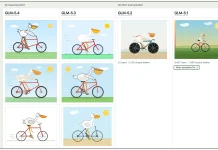


The Chinese lab shares weights across layers that run multiple passes, deepening the network without raising parameter counts.
Z.ai released GLM-5.4, the Chinese lab’s first model to use a looped transformer architecture. In that design, a group of layers shares one set of weights and runs for several iterations, refining hidden states from the previous pass. Z.ai describes the approach as a way to build a deeper network without increasing the parameter count.
The release follows Thinking Machines Lab’s Inkling 2 Mini, which runs its middle layers three times per token to gain reasoning quality. Simon Willison tested GLM-5.4 through the Z.ai API after subscribing to the Coding Plan. He built an llm-glm plugin, then found that Tommy Hughes already maintains llm-zai.
Looping lets a lab spend more compute per token instead of more parameters, and Z.ai frames the tradeoff as deeper reasoning at a fixed model size. Operators weighing GLM-5.4 against OpenAI and Anthropic models get a closer match in output style than earlier GLM releases. Access currently runs through the Coding Plan subscription.
Open weights for GLM-5.4 remain unavailable, and Z.ai has not given a date for a release. Willison plans to retire his llm-glm plugin once llm-zai supports the new model. Two looped transformer launches from separate labs in one week make the architecture a pattern worth tracking.
What matters
- Z.ai shipped GLM-5.4 through its Coding Plan subscription, and open weights are not yet available.
- Looped layers add depth without new parameters, so builders gain stronger reasoning at similar serving cost.
- Watch whether Z.ai publishes open weights and whether the llm-zai plugin adds support for the new model.
Why it matters
Watch whether Z.ai publishes open weights and whether the llm-zai plugin adds support for the new model.
This GenAI News article was prepared in original wording using reporting and materials published by Simon Willison’s Weblog. Source reference: https://simonwillison.net/2026/Nov/23/glm-54/.
Drafted by the GenAI News review pipeline.