
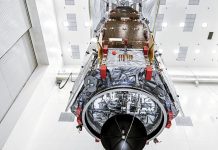


The observatory’s wide-field infrared camera will scan for small asteroids while probing the cosmos.
NASA’s Nancy Grace Roman Space Telescope will launch from Kennedy Space Center in Florida at the end of August, carrying a 300-megapixel infrared camera that can detect killer asteroids while also studying dark energy and dark matter.
A multi-institutional team of planetary scientists and astronomers, including Bryan Holler at the Space Telescope Science Institute and Andy Rivkin at Johns Hopkins Applied Physics Laboratory, will present the asteroid-detection proposal at the Europlanet Science Congress in The Hague in September.
For builders and data teams, Roman’s mission highlights the need for new software pipelines that can separate asteroid streaks from cosmic-ray artifacts and other glitches in massive astronomical datasets.
The September proposal will detail how Roman complements the James Webb Space Telescope for planetary defense, and the launch will test whether the telescope’s software can handle asteroid hunting in real time.
What matters
- NASA’s Roman Space Telescope launches in late August equipped to scan for killer asteroids.
- Its infrared camera will produce massive survey data that needs new asteroid-detection software.
- Watch for the September planetary-defense proposal at the Europlanet Science Congress.
Why it matters
Watch for the September planetary-defense proposal at the Europlanet Science Congress.
This GenAI News article was prepared in original wording using reporting and materials published by MIT Technology Review AI. Source reference: https://www.technologyreview.com/2026/08/05/1141200/nasas-roman-telescope-detect-asteroids/.
Drafted by the GenAI News review pipeline.